Aether
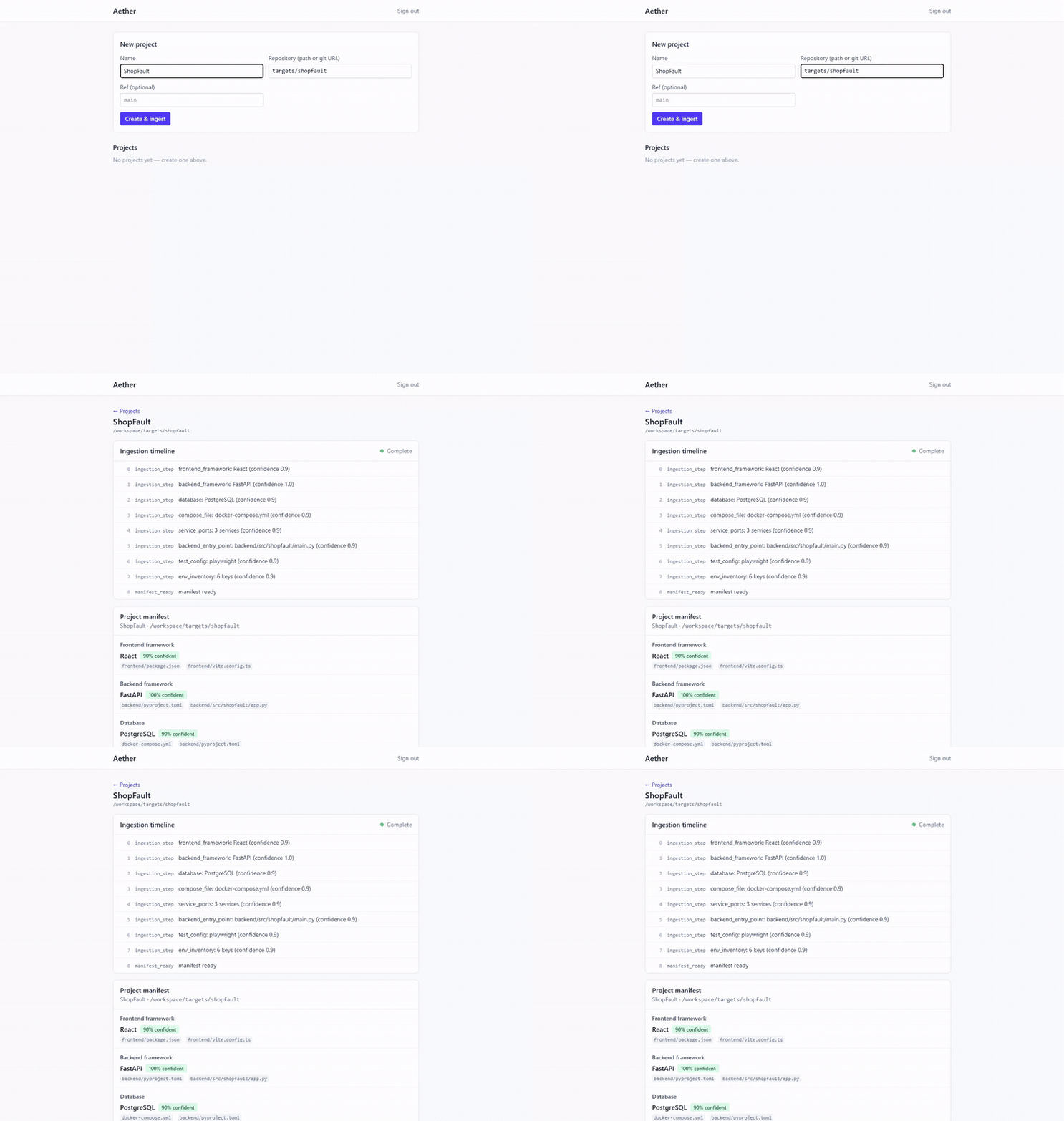
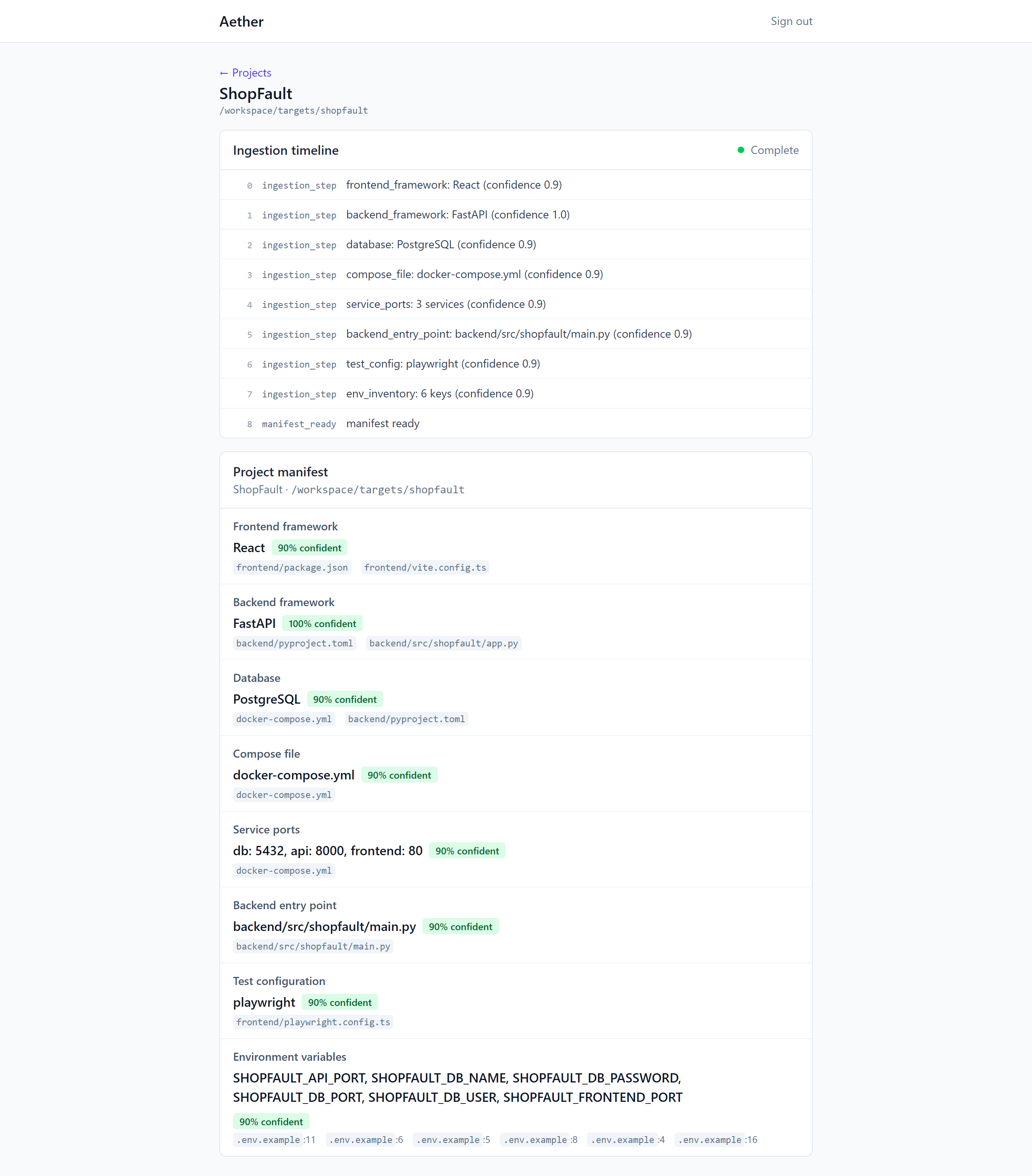
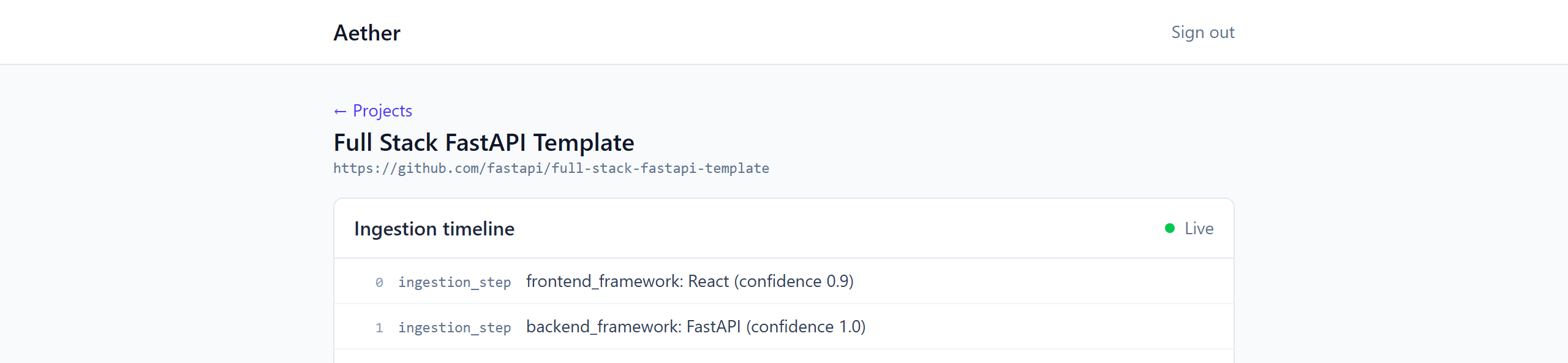
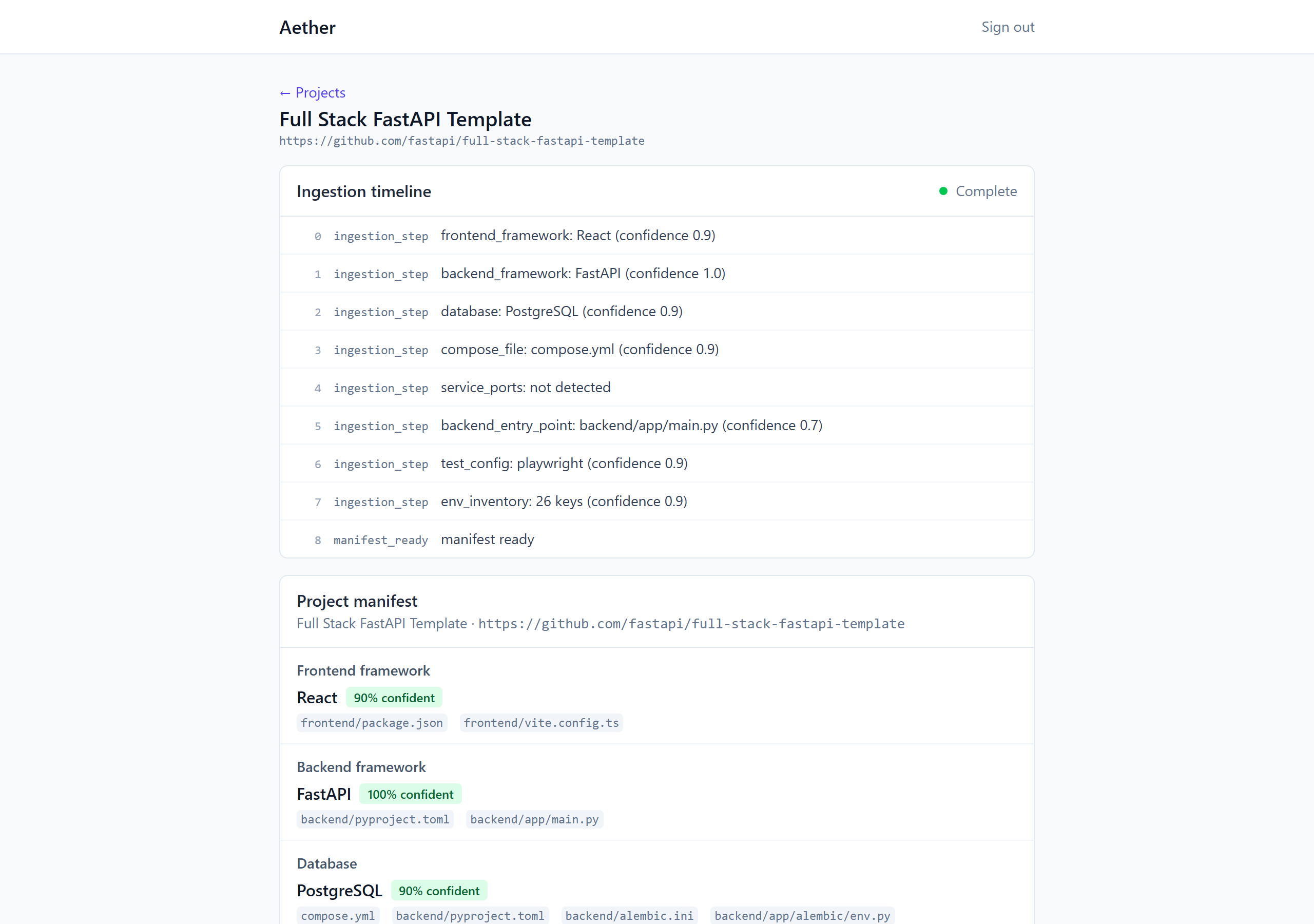
Point it at a repository and it streams back an evidence-backed model of the stack — every claim carrying a confidence score and the file paths that justify it.
Screens
Overview
Problem
Solution
Architecture
Tech stack
- Python
- FastAPI
- SQLAlchemy
- Alembic
- Pydantic
- PostgreSQL
- React
- TypeScript
- Vite
- TanStack Query
- Tailwind CSS
- pytest
- Playwright
- mypy
- Docker
- GitHub Actions
Engineering decisions
- PostgreSQL as the job queue instead of Redis or a broker — one fewer moving part, and job state stays transactional with the domain data it describes.
- A transactional event outbox: the state change and the event that announces it commit together, so a crash can never leave the stream disagreeing with the database.
- Server-Sent Events over WebSockets — the traffic is one-directional, and SSE gives replay-from-Last-Event-ID for free.
- Zero LLM calls in this phase. Detection is deterministic and therefore assertable field-by-field in an acceptance test.
- Environment files are inventoried by key name, never value, with a redaction filter on every event and log payload — a planted-marker test asserts nothing leaks.
- The target application lives in the repo but is treated as foreign: a standing isolation check fails the build if any application code imports it.
Challenges
- Guaranteeing a gap-free event sequence under concurrent writers required a dedicated per-stream counter allocated inside the same transaction as the event insert — an ordinary auto-increment column leaves visible holes when transactions interleave.
- At-least-once delivery means handlers must be idempotent; re-ingesting the same commit had to resolve to the same project version rather than quietly duplicating rows.
- Proving the queue's recovery paths meant testing against a real PostgreSQL rather than mocks — crash, stale-lock reaping, and retry semantics only exist at the database level.
Performance
- Local-path ingestion completes in roughly a second; a shallow clone of a public GitHub repository adds only the network time.
- Acceptance gate asserts on API and database facts rather than log text, and requires the target's duplicate-order bug to reproduce in at least 3 of 10 concurrent trials.
- 191 backend tests plus 22 target tests run against a real PostgreSQL in CI, alongside type-checking, import-boundary contracts, and Playwright end-to-end specs.
Lessons learned
- Building the skeleton first is slower for a month and faster forever — every later feature lands on joints that are already proven.
- A queue is a set of failure modes, not a data structure. Heartbeats, reapers, and idempotency are the actual product.
- Confidence scores are only worth showing if the evidence behind them is one click away; otherwise they are decoration.
- Shipping a deliberately buggy target alongside the tool made the acceptance criteria concrete instead of aspirational.
Future improvements
- A static 'twin': Python AST and tree-sitter extraction into a persisted code graph, with cross-layer URL matching.
- Dynamic observation through a sandboxed runner and scripted browser sessions that capture evidence.
- Evidence-driven, citation-first bug investigation layered on top of the manifest and graph.
- Test generation and sandboxed patch validation producing verified fix reports.
Engineering notesWhat's shaping this build.
Design goals, philosophy, planned architecture, and where the project stands today. No fabricated benchmarks — only what's actually driving decisions.
What's shaping this build.
Design goals, philosophy, planned architecture, and where the project stands today. No fabricated benchmarks — only what's actually driving decisions.
- Every claim the system makes must be traceable to a file path.
- No architectural joint left as a stub — the queue, outbox, and stream are real or the phase is not done.
- Module boundaries enforced by a tool in CI, not by convention.
- An honest target with a real bug, so acceptance criteria cannot be gamed.
Build the spine before the brain. Deterministic, verifiable plumbing first; the model comes later and inherits a substrate it can be trusted on.
The manifest becomes the base layer for a persisted code graph, which in turn grounds citation-first investigation — each phase adding capability without loosening the evidence guarantee.
Phase 1 is complete, tagged v1.0.0-phase1 and licensed MIT: queue, outbox, SSE with replay and reconnect, deterministic ingestion, the live frontend, the ShopFault target, CI, and an end-to-end acceptance gate. Static analysis and the investigation layer are next.